
With the rapid development of digital drawing, online education, and e-signature applications, pressure sensitivity has become a key metric for evaluating the naturalness and smoothness of writing or drawing experiences.
Traditional methods—such as electromagnetic or capacitive pressure sensing—often face challenges like complex structure, integration difficulties, and high costs.
Flexible pressure sensors (FSRs), known for their ultra-thin profile, softness, fast response, and easy integration, are emerging as the ideal solution for next-generation pressure-sensitive stylus pens.
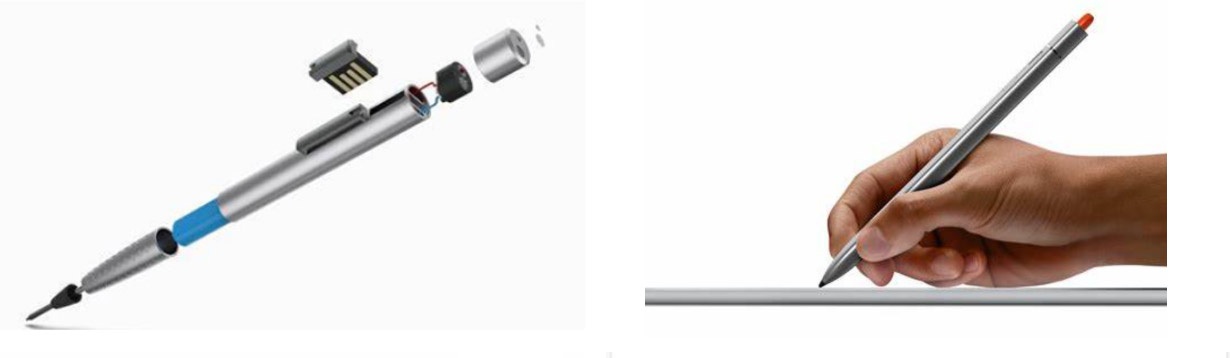
Operating Principle: The sensor is placed beneath the pen tip. When the user writes or draws, contact pressure between the tip and surface causes resistance changes within the sensor. This change is converted into an analog signal and processed by a microcontroller.
The higher the pressure, the lower the resistance and the higher the output voltage.
Enables different stroke thicknesses or shading effects based on pressure levels.
Response Time: Less than 10 ms, suitable for real-time applications.
Form Factor: Thickness can be less than 0.2 mm, ideal for tight internal space.
Microcontrollers (e.g., ESP32, STM32) collect the analog signals and apply filtering and calibration algorithms to determine:
Pen down and lift-off events
Pressure levels (supports up to 256 levels)
Dynamic changes in stroke characteristics (e.g., thickness, opacity)
Data is transmitted via Bluetooth, USB, or I²Cto tablets or computers.
Supports real-time interaction with software like Photoshop, Sketchbook, or handwriting recognition systems.
Sensor Placement:
Below the pen tip or inside the pen shaft along the pressure path
Can be modular for replaceable pen tip designs
Layered Architecture (Top-down):
Pen tip housing
Elastic medium (for uniform force distribution)
Flexible pressure sensor (dual electrode + pressure-sensitive film)
Flexible PCB (FPC) with signal routing
Control circuit with MCU and Bluetooth module
| Feature | Description |
| High Sensitivity | Detects as low as 0.1N of force, simulating natural pen pressure |
| Ultra-Thin & Flexible | Easily integrated into compact pen designs |
| Low Power Consumption | Near-zero power draw when idle; ideal for long-battery-life devices |
| Multi-Level Pressure Support | Enables expressive writing and drawing with fine-to-bold stroke control |



 English